
For many M. R. James aficionados, the name Robert Lloyd Parry will require no introduction. Since 2005, Robert has been touring his one-man M. R. James show, terrifying and enthralling audiences with an experience as close as possible to actually sitting down in front of James himself at one of the legendary Chit-Chat Club ghost story readings. In addition to his role as the world’s pre-eminent Jamesian storyteller, he has released a number of DVDs of his performances, edited several collections of ghostly tales, and co-authored and presented two documentaries on James’ life and works. I recently had the chance to sit down with Robert a stone’s throw from M. R. James’ beloved King’s College, Cambridge, to discuss his career, performances, and tracking down obscure publications by MRJ and his contemporaries.
Now based in the North West of England, I met up with Robert at the tail end of a week he’d been spending in Cambridge, undertaking research for a yet-to-be-titled follow-up to his recently compiled and edited short story collection Ghosts of the Chit-Chat, published last Christmas.
“Last year I compiled an anthology of stories written by people who were in the Chit-Chat Club with M. R. James, so this new book is kind of a sequel to that. It’s stories by people who weren’t in The Chit-Chat, but who were contemporary of M. R. James at Cambridge, or friends of his and so on, so it’s another anthology with very much a Cambridge slant to it. Where possible, I’m doing stories set in Cambridge or about Cambridge.”
The collection will feature a wealth of different ghost story authors, such as Richard Malden, F. Anstey, Shane Leslie, Barry Pain, E. G. Swain, Arthur Gray, as well as the mysterious ‘DNJ’, who published two stories in the Cambridge Review either side of the Great War, and whose true identity Robert hopes to finally reveal in the book.
The new collection will once again be published through Irish imprint Swan River Press, with whom Robert had also previously worked on his 2011 collection of Lucy M. Boston stories Curfew & Other Eerie Tales. The original Ghosts of the Chit-Chat anthology was born through conversations with Swan River’s founder, Brian Showers.
“When I first started doing the the M. R. James shows I made friends with Brian. He set up Swan River Press around about the same time as I was starting my touring. During one of our many conversations about M. R. James and ghost stories, he floated the idea for the book. At first it was just going to be a bit more like what I’m working on now – stories by M. R. James’ friends – but I soon realized that there was this small body of work by people who had actually been members of the Chit-Chat, and so it became based around that. I was quite pleased that things just kind of tumbled into place the more I researched it.”
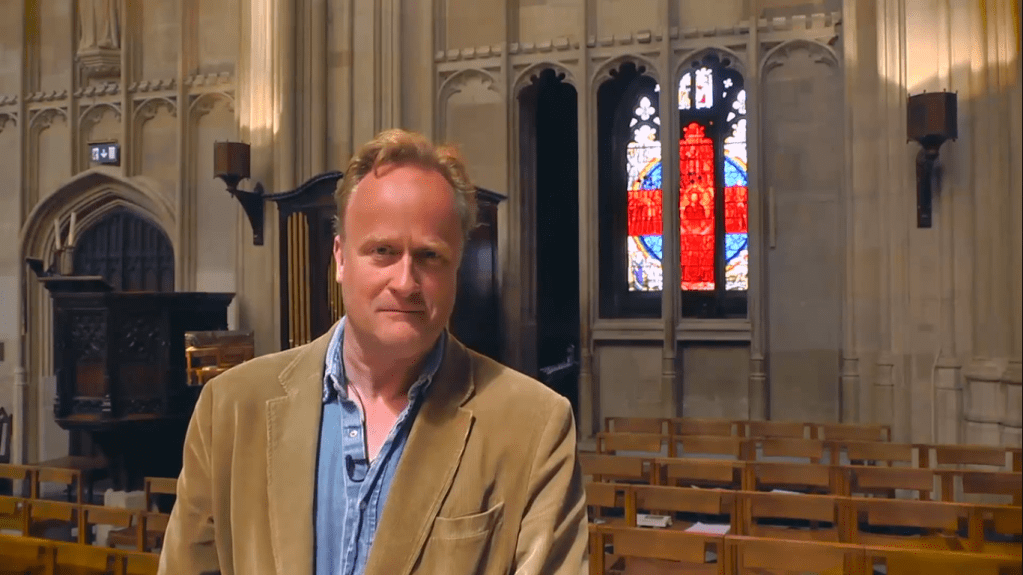
At the time of writing, the full selection of authors to be featured in the upcoming collection has yet to be finalised. Robert has been hard at work researching figures for inclusion in the archives of various Cambridge colleges, which he admits has been slightly more difficult given present circumstances.
“With everything being shut it’s hard to get to the sources you want, but I had a really good day in the King’s College archive this week looking at some letters by a writer called Barry Pain, who’s a little forgotten now. He corresponded with Nathaniel Wedd, who was an exact contemporary of M. R. James and a classicist. He [Wedd] was kind of the opposite of M. R. James in that he wasn’t an old Etonian; he was more of a free thinker and not so conservative, yet there was this mutual respect between him and James. Unfortunately I haven’t found any ghost stories by Nathaniel Wedd, but I did discover that there are two unpublished novels of his, so next time I visit the archives I’m going to take a look at them. I mean they may be unpublished for a reason…”
Robert had also visited the Pepys Library at Magdalene College to consult A. C. Benson’s vast 180-volume diary, and we discussed his relationship with James, particularly with regard to the disapproval Benson occasionally expressed toward James, as quoted in Michael Cox’s 1983 biography M. R. James: An Informal Portrait.
“I think it’s the longest diary ever written or something like that. Extracts have been published, but the whole thing never will be, there’s just too much of it. I kind of suspect that very few, if any, have read the whole thing. I was just checking references in the diary, and it’s very interesting. Benson and James were old, old mates, and you do often have double-edged feelings about your friends, don’t you? It’s spread over the course of that many volumes, and it’s what he was feeling at that particular time. I think things are exaggerated because of a couple of quotations in the Cox biography.”
In addition to his long-established M. R. James performances, as an art historian Robert has for a number of years conducted a series of guided tours at Cambridge’s Fitzwilliam museum. James himself served as the museum’s director between 1893-1908 (previously assistant director), and Robert in fact spent some time working there himself immediately prior to founding the Nunkie Theatre Company.
“It was a lottery funded job to write the content for an online guide of the collections. It was basically researching 300 objects from across the whole collection, writing about them, and getting them online. It was a lovely job. It came to an end when the lottery funding ran out, and that’s when I started doing the M. R. James stories, trying to snatch a living from that. In a way I burned my bridges as far as museum work goes. I left that behind rather, and part of me would like to have carried on, but there we go.”
Rather appropriately however, Robert’s very first performance took place within the Fitzwilliam, in a space James would have been intimately familiar with:
“What I describe as James’ office is the Founders Library, which is the most magnificent room in the oldest part of the museum. It always was and remains the office of the Keeper of Manuscripts. In James’ day there wasn’t a Keeper of Manuscripts – it was just one overall boss and he had an assistant. The Keeper of Manuscripts still sits at a desk at one end of the room, surrounded by these magnificent mahogany bookcases and a lovely fireplace, and it was in front of that fireplace that I first did my show. That room really fires the imagination most of all. I first did it to tie in with an exhibition at the Fitzwilliam of illuminated manuscripts in Cambridge collections, and of course M. R. James was the éminence grise behind that. I did Canon Alberic’s Scrap-Book and The Mezzotint there, and they fit in well. In the story, the scrapbook ends up in the ‘Wentworth Collection’, so I renamed it the ‘Fitzwilliam Collection’ for the performance.”
I also asked Robert about any legacy, visible or otherwise, left from James’ time at the museum.
“There are the things that he acquired when he was the director. I can’t remember in terms of paintings and so on, but certainly a lot of manuscripts. There’s also a lovely picture of the staff of the Fitzwilliam Museum in the 1890s. They’re in the painting gallery, with lots of pictures hung terribly close together. M. R. James is in a group of about eight, and they’re looking at a painting of one of the founders.”
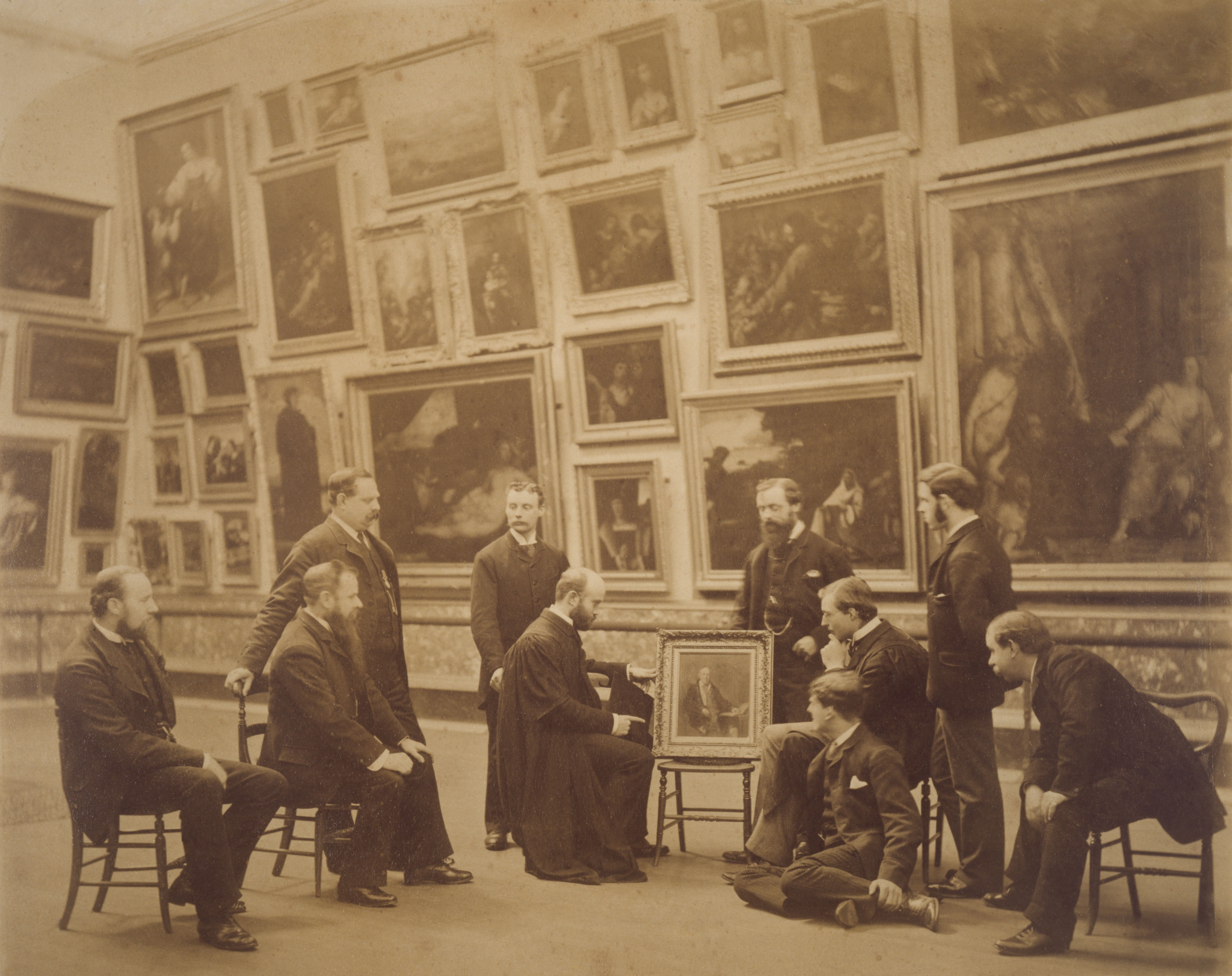
“A book that’s worth reading is The Fitzwilliam Museum: A History by Lucilla Burn. It was the museum’s bicentenary [in 2016], and they published a nice illustrated book, which discusses, amongst other things, the museum’s directors. You find out what James did in the role, which wasn’t an awful lot, but he was very modest about it. The guy who came after him [Sir Sydney Cockerell] was a real museum professional, and he said something along the lines of “I found a pigsty, and I turned it into a palace”, so the pigsty was under James.”
Robert has been touring his M. R. James shows for over fifteen years now, and has been given the chance to perform in some venues with a particularly impressive Jamesian pedigree.
“I have a regular gig at the provost’s lodge in Eton – an annual show there because the current Provost’s [The Rt. Hon Lord Waldegrave of North Hill] wife is a distant relation of M. R. James, and obviously with him being the provost they’re very keen on James. Once a year they invite selected members of staff and selected boys to the lodge, and in front of the fireplace I do a show. A couple of years ago I did a show in the provost’s lodge at King’s as well. I’ve also performed in the church at Great Livermere, and once in King’s College Chapel, which didn’t really work as it’s far too echoey.”
Over the years, Robert has adapted a wide selection of James’ stories for his performances and covered many of his most well-loved tales, from ‘Oh, Whistle, and I’ll Come to You My Lad’ to Count Magnus. I asked him about the process of bringing James’ stories to the stage, and whether there were any yet-unperformed tales he’d particularly like to add to his repertoire.
“M. R. James’ economy is one of the great things about him. People think he’s got this fruity language, but he doesn’t really; he’s got an old fashioned, deliberately mannered language, but what he writes is very tight. Those stories that aren’t fail because of it. Some of them I tell more or less as they’re written, but I’ve had to adapt a couple of them. The Residence at Whitminster I did condense and try to give it a bit more of a shape. I think James does sometimes get carried away with “stage Cockneys”. He found himself so hilarious. In Casting the Runes you’ve got about a page of the cockney ticket collector, so I cut a lot of that. He also loved mimicking old fashioned writing, so in The Residence at Whitminster you’ve got the girl’s diary that goes on and on and on.”
“I do feel a bit ashamed for having done this so very long, but there is still an audience for it. I think I’ve done all those that I consider to be the best ones, but there are couple left I could quite happily do. An Episode of Cathedral History I’ve always liked very much. I used to do The Stalls of Barchester Cathedral, but I couldn’t come up with a way of making it work as a live performance because it’s mostly diary entries. Me just reading the diary entries is rather boring to look at.”
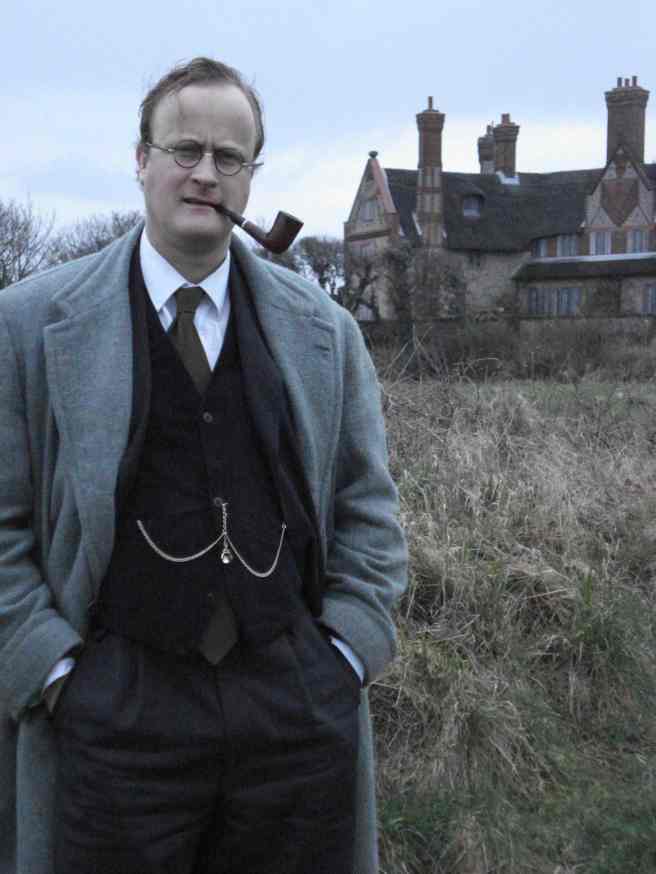
The recent social restrictions have naturally affected Robert’s usual touring schedule, and stalled some planned performances that had been due to begin this year.
“Since last March I’ve not really been able to perform. I was able to fit in a couple of M. R. James shows in October last year, between lockdowns, but that’s all I’ve done. I had a whole tour of an H. P. Lovecraft show set up for last spring and within ten hours that had just disappeared. It was a performance of two Lovecraft stories: Pickman’s Model and The Music of Erich Zann. I did it as a supported project by Harrogate Theatre and performed it a couple of times. I wasn’t fully pleased with it but I was going to take it on tour when COVID hit. Whether I’ll revive that tour or not I don’t know. I did both of them online and they went down quite well, so I might.”
Aside from the planned H. P. Lovecraft shows, Robert has previously performed works by several other authors besides M. R. James. I asked him how he’d found the experience as an actor of stepping outside of the world of ghost stories.
“I did The Time Machine by H. G. Wells as well. The problem with that was, I was proud of the show and people liked it, but more often than not it was played before really bad houses. I’ve found an audience for M. R. James, and I was surprised there wasn’t one for H. G. Wells. There are a lot of authors I would quite like to do, but whether they’d get an audience I don’t know. I’d like to do Arthur Machen, but the world at large would not come to see Arthur Machen. So that’s the corner I find myself in. There are plenty of good stories out there, but it’s a big undertaking to adapt, write, learn and rehearse them.”
Naturally, with a shared interest in James’ published works, Robert and I ended up on the topic of book collecting, and he briefed me on some of his favourite personal acquisitions.
“My best ever M. R. James buy was on eBay. Somehow I got a copy of Eton & King’s, the first edition, for £10. There were other people bidding as well – I don’t know how I got it. I was chuffed with that, and had it on my shelf with a few other books. A while later, Brian Showers in fact was visiting, and he picked it up and looked through, and then suddenly stopped and said ‘Have you seen this?’ I hadn’t, but inside was a letter from M. R. James to the the original owner of the book saying “thank you for your letter”, headed “The Lodge, Eton College”.

“I recently bought this book that was actually by E. G. Swain; not published in his name but under a pseudonym. It’s a selection of plays that he wrote for the choristers at King’s, with M. R. James. I don’t think James necessarily helped him write them, but it was part of the entertainments they put on, the culmination of which of course was A School Story. He wrote that for the choristers, but leading up to that, there were these kind of skits, pantomimes and comic plays. Occasionally in G. David’s [bookshop] around the corner I have found some books by James. I found The Biblical Antiquities of Philo in there, which I was quite pleased with. I’d long wanted to find a copy of Old Testament Legends browsing an antique shop, but I never found it in real life so ended up ordering it online.”
Robert has released a number of professionally-filmed DVDs of his performances, and in recent years has made and presented two documentaries on James’ stories, 2017’s Wits in Felixstowe, which delves into the background and writing of ‘Oh, Whistle, and I’ll Come to You My Lad’, and 2019’s Dim Presences, which covers A Warning to the Curious. Both are excellent documentaries and well worth seeking out for any James fan, and I wondered if there may be a third instalment in the pipeline.
“Christopher Thom, who I collaborate with, is a cameraman and a director, and we work on them together. In fact next week we’re going to be filming a new DVD which I’m thinking of calling M. R. James: Live at the Chit-Chat. It’s going to include Canon Alberic’s Scrap-Book and Lost Hearts, just candle lit and single-take like the other DVDs I’ve done; very simple and straightforward. For that DVD I’ll do a short documentary – probably it’ll just be a talking head of me discussing the Chit-Chat Club. But yes, I’d love to do another full-fat documentary. I want to go to Scandinavia and do one about James’ time there, covering Count Magnus and Number 13. I will at some point release a Scandinavia DVD with those two stories on it, and I’d love to do some filming there. I’ve got a couple of things I think I’ve found that are not generally known about – the inspiration for Count Magnus and so on.”
Despite Robert’s extensive filmed back catalogue of M. R. James tales, he has no desires to produce any fully-fledged filmic adaptations of the stories himself.
“I do think the best way of presenting them is simply as storytelling. I mean I certainly I wouldn’t turn my nose up at that kind of part, but it’s not something I’m planning to do myself. I was in Mark Gatiss’ documentary about M. R. James [2013’s M. R. James: Ghost Writer]. I remembered he had expressed a desire to do an adaptation of Count Magnus, so I said, “if you ever do Magnus then consider me for Mr. Wraxall”.”
With life returning to some semblance of normality, Robert will be returning to the stage with a full tour beginning this Autumn. He currently has a string of dates for M. R. James performances planned, running from October to December, and full details of the schedule and tickets can be obtained through the Nunkie Theatre Company website.
I would like to offer my sincere thanks to Robert for taking the time to conduct this interview. If you would like more information about his M. R. James project and other endeavours, please visit the Nunkie website. Robert also has a fantastic YouTube channel which is regularly updated with readings of stories by James and many other authors, and a Bandcamp page with a selection of audiobooks available for purchase. Both Wits in Felixstowe and Dim Presences are currently available to stream via Amazon Prime. Ghosts of the Chit-Chat is still available as a paperback through Swan River Press.
Duncan J. Rule.

 Antiquarian Ghosts
Illuminating interview.Sterling work.
Many thanks.
LikeLike
Much appreciated, Don. Glad you enjoyed the interview.
LikeLike
Excellent article. I must try to attend one of Robert’s live performances.
LikeLike