
Throughout his life, M. R. James was involved in the publication of several facsimile editions of important medieval manuscripts, for which he would provide introductions and detailed notes in the same vein as his extensive MS. catalogues. These volumes were primarily produced by the exclusive bibliophilic society the Roxburghe Club, of which James became a member in 1909, but several were issued by other publishers and institutions.
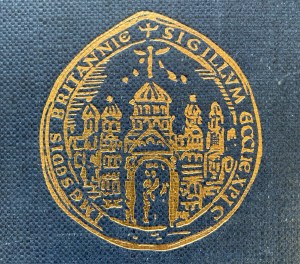
One such book is The Canterbury Psalter (1935) – a limited printing of a facsimile edition of the 12th century Tripartitum Psalterium Eadwini (Trinity MS R.17.1), and also known as the Eadwine Psalter; so named for the scribe Eadwine of Christ Church, Canterbury, who is believed to have overseen the production of the book (although his exact identity and role in the creation of the manuscript remain unclear). The original work, now housed in the Wren Library at Trinity College, Cambridge, is a particularly exceptional example of an illuminated manuscript of the time, and as a psalter is predominantly comprised of the Book of Psalms, written in Latin, Old English and Anglo-Norman, and copiously illustrated throughout.
James had covered the MS. extensively in his four-volume The Western Manuscripts in the Library at Trinity College, Cambridge: A Descriptive Catalogue (Cambridge University Press, 1900-1905), but had commented at the time that he was unable to describe the illustrations in the full detail he desired, and hoped to be able to return to the task at a later date in a separate publication. That opportunity eventually presented itself in 1934 when James was asked by the Friends of Canterbury Cathedral to edit and supply an introduction for the facsimile, a task which by all accounts he was most enthusiastic about. As he states in a letter to Gwendolen McBryde dated 31st January 1934:
“And I have hopes of the illustrations of the Canterbury Psalter turning up before long which would furnish employment of the kind I like. I have, in fact, begun to write the introduction to my proposed description of it.”[1]
James’ involvement with the book is mentioned in a further four letters to Gwendolen, although predominantly as a series of complaints about the punctuality of the publisher in supplying illustrations and proofs. He seems to have completed his work somewhere between the 6th and 17th of April 1935 despite having “been extremely lazy”.
The finished book, printed by Percy Lund, Humphries & Co., is a rather large and weighty volume consisting of an extensive fifty-six page introduction and description by MRJ, a short index, and the facsimile of the MS. itself as monochrome plates, with four pages also reproduced in full colour.
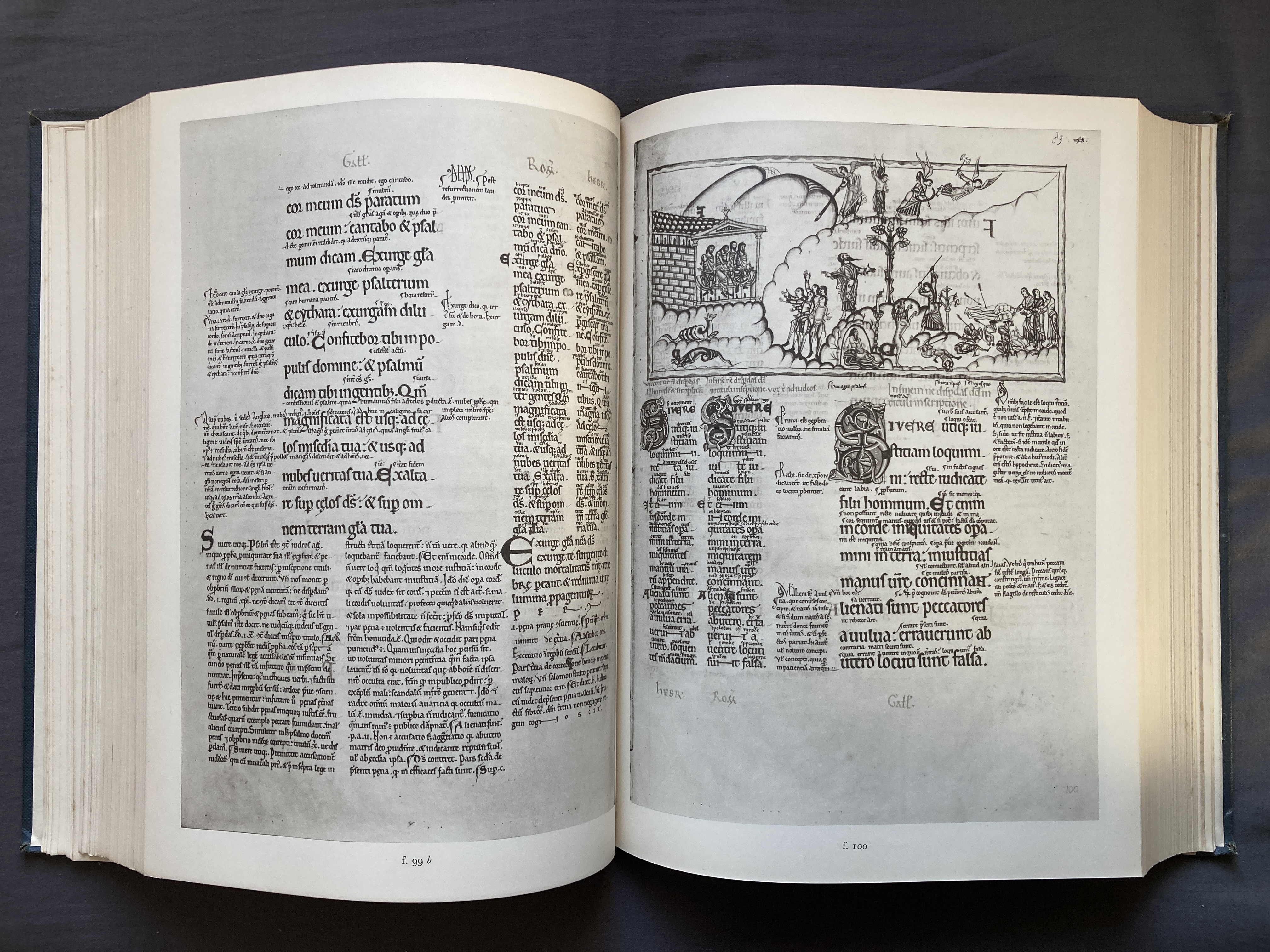
James introduces the book with a detailed description of the physical tome, some comments on Eadwine, and the history of the manuscript itself:
“The primary object of the present introduction is to furnish an explanation of the pictures in this famous manuscript. With the written text I am not so nearly concerned, though much of it is of the highest interest, and, naturally, enough will have to be said about it to give the reader his bearings. A beginning may be made by setting out the main facts about the book.
It is a massive volume, measuring 18 by 13 inches, and containing 286 leaves, plus fly-leaves. It is bound by wooden boards which have the remains of a sixteenth-century leather covering with fine gold tooling. A metal boss in the centre of each cover bears a Tudor rose; the book has been re-backed, the clasps are gone.
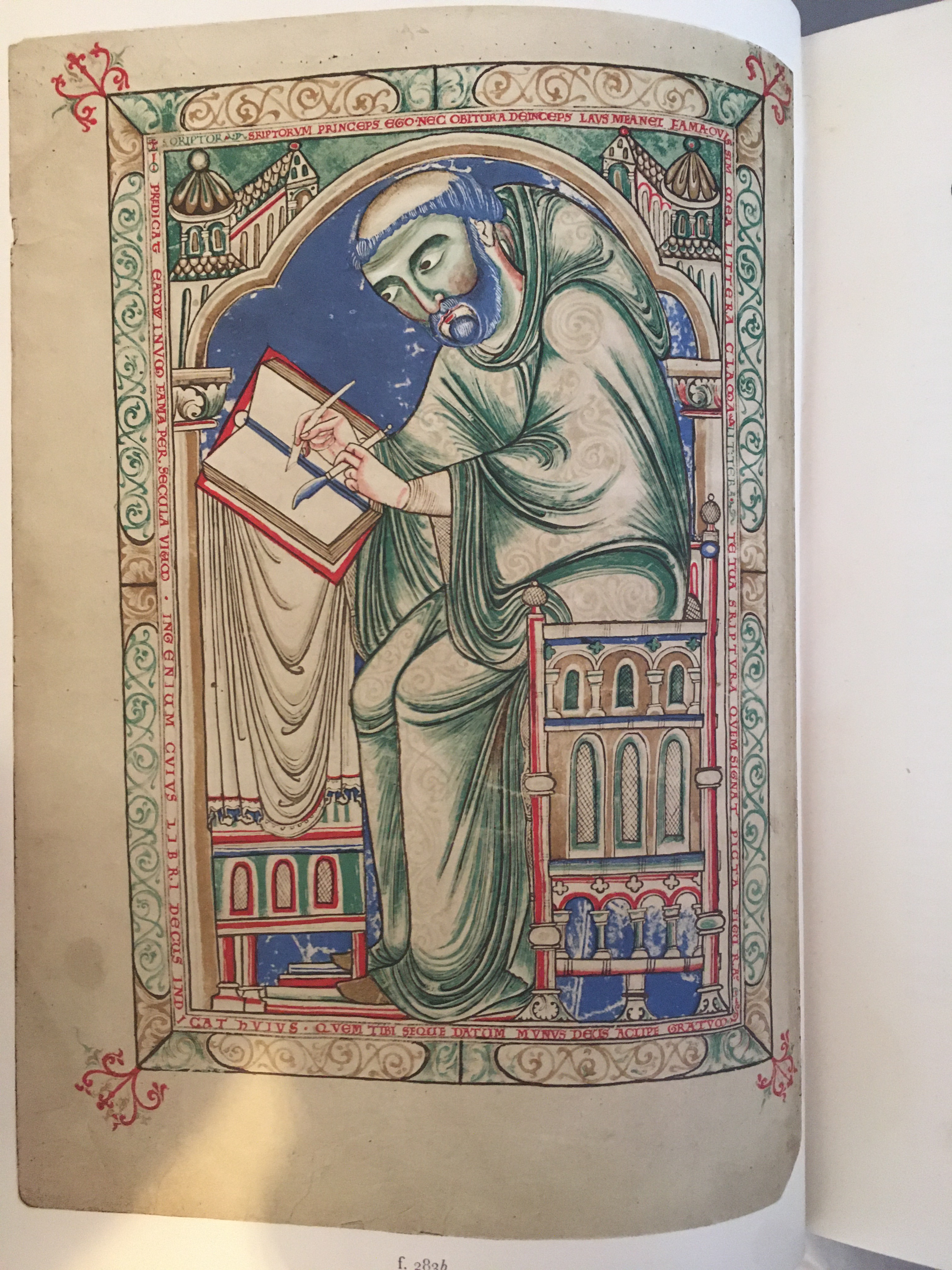
It was written at Christ Church, Canterbury, about the middle of the twelfth century by a scribe named Eadwine, a monk of the house. His portrait, drawn by himself, occupies a whole page in it. No facts about him are forthcoming from other sources: he is not even mentioned, so far as I see, in the lists of the Christ Church monks drawn up and annotated with great care by W. G. Searle in his book Christ Church, Canterbury (Cambridge Antiquarian Society, 1902). We can, however, tell something about the history of the book. It is entered in the medieval catalogue of the Christ Church library, which was drawn up for Prior Eastry early in the fourteenth century, and is preserved in the Cottonian MS. Galba E IV. It was last edited by me in 1904 in Ancient Libraries of Canterbury and Dover. Here on p. 51 we have a list of Libri de armariolo Claustri, i.e., “books kept in the press in the cloister” – a kind of reference library; third in this list (No. 323 in the whole catalogue) is
Tripartitum psalterium Edwini.
At Canterbury it remained until it was presented to Trinity College, Cambridge, by Thomas Nevile, Master of Trinity, 1593-1615, and Dean of Canterbury. It is No. 110 in the list of 126 MSS. which he gave, and is entered as
Psalterium cum tribus translationibus
Its present press mark is R.17. 1 (No. 987 in my catalogue).
I will add that it was possibly not the only book of Eadwine’s making at Canterbury: for in the catalogue referred to just now we find, in a list of Libri Anglici, i.e., Anglo-Saxon books, a “Liber Edwini Anglice” of unspecified contents. (Anc. Lib., p. 51, No. 319).”
The portrait of Eadwine mentioned by James, unusual for an illuminated manuscript, is one of the four pages beautifully reproduced in colour in this facsimile. The portrait itself is bordered by an inscription in Latin which provides us with some information on the origins of the manuscript, and which James helpfully transcribes in his accompanying notes as follows:
“SCRIPTOR (sc. dicit). S(C)RIPTORVM. PRINCEPS. EGO. NEC. OBITVRA.
DEINCEPS
LAVS MEA NEC FAMA. QVIS (continued down R. side).
SIM MEA LITTERA CLAMA.
LITTERA (sc. dicit). TE TVA S(C)RIPTVRA. QVEM.
SIGNAT PICTA FIGVRA (then follows a monogram of I and O referring to the top L. corner, where it is repeated).
PREDICAT EADWINUM FAMA PER SECULA VIVUM.
INGENIVM CVIVS LIBRI DECVS IND (bottom)
ICAT HVIVS QVEM TIBI SEQUE DATUM MVNVS DEUS ACCIPE GRATVM.”
As is often the case with Latin passages in his work, MRJ did not provide an English translation, presumably under the (likely correct) assumption that the readership of the book would understand the original. A later translation by T. A. Heslop[2] reads thus:
“The scribe: I am the chief of scribes, and neither my praise nor my fame shall die; shout out, oh my letter, who I may be.
The letter: By its fame your script proclaims you, Eadwine, whom the painted figure represents, alive through the ages, whose genius the beauty of this book demonstrates. Receive, O god, the book and its donor as an acceptable gift.”
If you’re interested in looking at the psalter itself in more detail, thanks to the wonders of modern technology the entire manuscript has been scanned and digitised by Trinity College (along with many others in the collection) and can be viewed and downloaded as high-resolution images on the Wren Library website.
I managed to acquire a copy of The Canterbury Psalter towards the end of 2020, although have been holding off on adding it to the collection pages until I’d had time to give it the attention it deserves in the form of this article. Despite its limited print run there are actually a number of copies available for sale at the time of writing, although most are priced substantially higher than the sum I paid for mine.

The copy I purchased contains an elaborately hand-written presentation page (the erased pencil lines are still partially visible) on one of the blank fly-leaves toward the front, gifting the book to John Victor Macmillan, D. D. (1877-1956). J. V. Macmillan, the son of Alexander Macmillan, co-founder of publisher Macmillan & Co., and uncle of future Prime Minister Harold Macmillan, was a former Etonian and residentiary canon of Canterbury Cathedral, Archdeacon of Maidstone and Bishop of Dover, who in 1934 had moved on to become the second Bishop of Guildford. The page is signed by the dean at the time, the famous Marxist “Red Dean of Canterbury”, Hewlett Johnson, along with canons Samuel Bickersteth, T. G. Gardiner, Edward H. Hardcastle, and J. M. C. Crum. More images of the book are available on the collection page.

© National Portrait Gallery, London
It’s endlessly fascinating to me when a book of some age comes into my possession bearing a name, signature or some other connection to a former owner, and in circumstances where the individual is particularly noteworthy allowing the opportunity to research them in more detail. It’s certainly one of the joys of collecting old books that traces are often left behind that connect them to a former life – and in cases like the Eadwine Psalter itself leave behind a puzzle to be solved. I suppose like many things we never really “own” our books, but merely look after them for the next person.
Duncan J. Rule
[1] Letters to a Friend, ed. Gwendolen McBryde (Edward Arnold, 1956), p. 200.
[2] The Eadwine Psalter: Text, Image and Monastic Culture in Twelfth-Century Canterbury, ed. M. Gibson et al (Penn State University Press, 1992), p. 180.
 Antiquarian Ghosts