
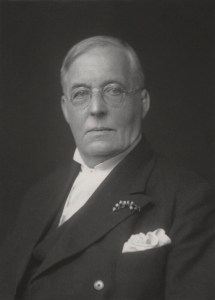
© National Portrait Gallery, London
Montague Rhodes James was born on 1st August 1862, and spent his early years at the Rectory in Great Livermere, Suffolk, owing to his father Herbert’s occupation as the rector of St. Peter’s Church in the village.
Following an early education at Temple Grove School in London, James enrolled at Eton College in 1876, before moving to study at King’s College, Cambridge in 1882 as an undergraduate. He would remain at King’s as a don, and subsequently provost until 1918, when he returned to Eton and assumed the provostship there. James passed away on 12th June 1936 in the provost’s lodge at Eton, aged 73.
As a scholar, James was a highly respected medievalist and expert on the biblical apocrypha. Over the course of his life he published a great many texts on these subjects, and is in particular noted for his detailed cataloguing of the medieval manuscript collections held by numerous institutions and private collections within Great Britain, including many of the Cambridge colleges.
Today, however, James is perhaps best known for his ghost stories, of which thirty-three completed examples were published during his lifetime (and a number of further incomplete stories exist). These stories were initially intended to be read aloud to audiences of his peers, and the first such reading took place on 28th October 1893 at the Chit-Chat Society in King’s College. James subsequently submitted some of his stories for publication in various contemporary magazines.
The first complete book of M. R. James’ ghost stories to be published was the collection Ghost Stories of an Antiquary, printed in 1904 by Edward Arnold of London. Proving extremely popular, the collection was followed by the publication of three further volumes: More Ghost Stories (1911), A Thin Ghost and Others (1919), and A Warning to the Curious and Other Ghost Stories (1925). A final fourth volume collecting all twenty-six stories from these books, along with four additional tales published subsequently, was published in 1931 as The Collected Ghost Stories of M. R. James.
Outside of his scholarly works and ghost stories, James also penned two guidebooks: Abbeys (1926) and Suffolk and Norfolk: A Perambulation of the Two Counties with Notices of their History and their Ancient Buildings (1930), along with a memoir of his time spent at both Eton and King’s college, Eton and King’s: Recollections, Mostly Trivial, 1875–1925 (1925). Within the realm of fiction, James also tried his hand at children’s literature with The Five Jars (1922).
Many of James’ ghost stories drew heavily on his own life, work and interests, and form what is now often referred to as the classic “Jamesian” tale: a scholarly gentleman encounters an antiquarian object of some description in an idyllic English setting, which when removed or examined unleashes some malevolent supernatural force upon the protagonist. This is of course a considerable oversimplification, but nevertheless provides an idea of the general feeling of many of James’ stories and those inspired by his work. Often, the stories take place in locations and settings that James was intimately familiar with; Suffolk and Norfolk being two counties particularly associated with his writings.
These stories set the standard not only for the Jamesian tale as we know it today, but for the entire tradition of the modern ghost story, and have proven hugely important and influential well over one hundred years later. James’ stories are to this day frequently adapted, analysed and imitated, and they have lost nothing of their power to entertain and chill those who read them.
 Antiquarian Ghosts